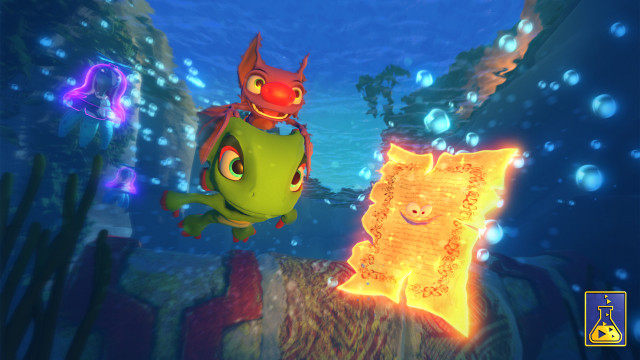
Banjo-Kazooie’s influence on Yooka-Laylee is unmistakable. Obviously, being largely composed of BK developers from Rare, Playtonic Games has made no secret of their desire to create Yooka-Laylee in the mold of their beloved 90s platformer. Even with only a tertiary knowledge of Banjo (I was always more of a Crash Bandicoot guy, myself), I can see where the changes happened. You change out Jinjos for “Ghost Writers,” replace Notes with “quills,” swap out Puzzle Pieces for “Pagies,” and trade one musical-instrument pun for another, and, suddenly, you’re more than two decades in the future with a Kickstarted successor named Yooka-Laylee.
But, Yooka-Laylee is far from a name-swapped Banjo-Kazooie with modern graphics. Yooka-Laylee realizes that being a successor is more than just doing the same thing; it takes ambition and improvement – not only reverence and nostalgia – to create a worth follow-up. Yookla-Laylee is informed by the past while eschewing the modern love affair with it.
Collection Edition
None of this is to say that Yooka-Laylee won’t feel like Banjo-Kazooie, because it certainly will. You’ll still travel around, going after those ever-so-enticing collectibles in different worlds all connected by a hub, with one of those collectibles allowing you to unlock more worlds, only this time, you’ll be controlling a lizard and his flying bat buddy instead of a honey bear and his bird. Species aside, you’ll get to use your jump, double jump, floating jump, uphill climb and so on to traverse a variety of different environmental challenges with the only goal being to collect more shit.
This is exactly what Playtonic wanted – to create a game of a now-extinct genre that feels like one of its highlights. But, with Yooka-Laylee, they’ve also made significant improvements to the collect-em-up formula, specifically that of Banjo-Kazooie.
As they promised early in the development cycle, Playtonic made a serious effort to infuse meaning into both the collectibles and the act of collecting them. Almost everything hidden throughout the five worlds of Yooka-Laylee directly improves your gameplay experience upon finding them. Quills are used to purchase new abilities in each world (taking a pagie from Banjo-Tooie’s Grand Tome), PlayCoins open up a new arcade game, and even Pagies (Puzzle Pieces) can now be used to expand worlds – not only unlock them.
And even the collectibles that do nothing more than provide a Pagie are handled better than in previous installments. For instance, Jinjos in Banjo-Kazooie (five differently-colored creatures that would simply hide throughout the world for you to find) have become “Ghost Writers,” and each color of ghost will need to be captured in a different way – the red ghost needs to be defeated in combat, the purple ghost needs to be fed a projectile, the blue ghost is invisible until revealed, etcetera.
Powerful Tonguing

Not only did Yooka-Laylee improve the collectibles, but they also improved the methods by which you can collect them. Yooka and Laylee have a roll ability that allows them to move more quickly and travel up most hills without sliding down. In Banjo-Kazooie (and Tooie, for that matter), this method of traveling entailed Kazooie lifting Banjo on her back and walking up these hills. The issue was that there was no reason to travel in any other way, since it was the fastest and least-limiting method. Yooka-Laylee has fixed this conundrum while adding even more depth to the rest of the gameplay.
It’s a simple concept – a power bar (no, not the kind you bring on hikes). Do you want to use one of the more taxing abilities? That will cost you power that will drop dramatically when using the more desirable skills, including the roll. This stops you from spamming those abilities and gives you another resource to manage while platforming, making the entire endeavor a more in-depth experience that requires at least a modicum more thought.
Also, because you have a lizard instead of a bear, Yooka-Laylee uses a slimy tongue to expand upon the projectile system from Banjo-Kazooie. It’s not simply a game of swallowing rocks to shoot out. You can now inhale several different types of “berries,” that give you elemental properties such as fire, water, snow and grenades (the fourth element), and these act as both combat aids and layers to puzzle platforming.
Even more tongue action comes after you gain the ability to take on the properties of things you eat. You can eat some honey out of a beehive to become sticky, allowing you to roll up steeper hills, and you can eat some coal out of a fire pit to become immune to fire, and all of this will help you solve more environmental puzzles.
Otherworldly Bosses

A slight point of criticism comes from the knowledge that Yooka-Laylee has only five main worlds that work off its hub. Even though world four was more on the uninspired side, consisting mostly of mini-games rather than platforming puzzles, that’s not the true weakspot of the worlds. You’ll find that, as the game goes on, you’ll have less and less incentive to keep finding those collectibles. After a while, you’ll have more than enough Quills to get every ability in the game seemingly twice over (though Quills are a good visual indicator to tell you if you’ve explored an area before). Power and Energy buffs won’t mean much to you, and neither will Pagies, as you are only required to collect 100/145 of them to unlock the final boss fight. I reached that about ten minutes into the last world, and I only continued in that world long enough to kill its boss.
While we’re on the topic, some bosses are better than others, but the final boss fight – in so many words – sucks. It’s the wrong kind of born-of-the-90s. It has several different tiers, all of which you’ve seen before, culminating in an uninspired segment of the boss creating large shockwaves on the ground that you have to jump over (a mechanic, by the way, a previous world boss already used) before eventually tricking the boss into killing himself with guided missiles that you lead into him. Yooka-Laylee even includes what I suspect to be a winking, on-the-nose line about how bosses “will never learn,” but it seems that it’s Playtonic that most needs to study. I’d start with a lesson in the evolution of boss fights throughout the early 21st century.
That being said, Yooka-Laylee’s world bosses are interwoven really well, highlighted by the final two worlds’ bosses that take place in a modified alternate play version, one with the Donkey-Kong-Country-style mine-cart game and another through altering your physical form. Each of these encounters is a pleasant surprise and an inspired variation that keeps my interest as a player. I just wish some of that ingenuity was carried over to the game’s last hurrah.
Conclusion
Still, though, it’s hard to ignore the obvious treat Playtonic Games has presented us with Yooka-Laylee. They simply don’t make games like this anymore. But Yooka-Laylee isn’t just that one that “takes us back”; it fondly remembers the good-old days with a modern flare.
By not holding up Banjo-Kazooie as the last bastion of platformers, Playtonic was able to turn Yooka-Laylee into an overall improvement on the formula it so closely mimics. We’re coming up on a relatively dry patch of 2017, and, if I’m counting on Yooka-Laylee to be my own personal flying lizard to carry me through it, I don’t think I could be in better hands.
-
More meaningful collectibles
-
Added gameplay depth
-
Imaginative world design
-
Creative bosses (overall)
-
Collectibles become less desirable over time
-
Uninspired final boss fight